Simple Tips to Reduce Stress: Easy Guide
Life is overwhelming at times. Work, family, and social duties leave one stressed without even noticing it between school and work. Your shoulders are tight, you are a worrywart who can’t think at night, and even minor issues appear enormous.
The good news? To feel better, you do not have to spend money on treatments and complex solutions. To soothe the mind and the body, we have been provided by nature with plain potent tools. These techniques have assisted thousands of years and science already demonstrates that they are indeed effective.
This manual will demonstrate how to reduce stress in a natural manner. They are simple to begin now and inexpensive or free, yet might have a genuine impact on the way you feel.
Stress and the Body: It is true that stress can cause serious physical and psychological problems affecting the body and mind of a person.
It is good to understand what will occur when you are stressed before knowing how to combat stress.
Whenever you are challenged, hormones are released in your body, such as cortisol and adrenaline. These chemicals get you ready to act – your heart goes up a notch higher, your muscles tighten and your mind clears.
This reaction allowed our ancestors to avoid life-threatening circumstances. However, nowadays, our interiors respond identically to traffic congestion, uncomfortable dialogues or over-scheduled days.
Stress is an actual issue when it lasts weeks and months:
- Sleep becomes difficult
- Your immune system weakens
- Aches and pains in the body get higher
- Memory and concentration are impaired
- Mood fluctuations occur more frequently
The answer is not to get rid of all the stress – it cannot be. Rather, you require mechanisms to deal with it efficiently.
Relaxing Breathing Exercises that Soothe Your Nervous System
The quickest time to relax naturally is to breathe. It is too easy to sound, but breathing exercises have a direct influence on your nervous system.
The 4-7-8 Breathing Method
It is a natural tranquilizer on your nervous system ordered by Dr. Andrew Weil.
Here’s how to do it:
- Inhale using nose and count 4 times
- Hold your breath for 7 counts
- Slowly breathe out using the mouth 8 times
- Repeat this cycle 4 times
Test it before going to sleep, when you are going through a stressful time or when you are just in need of feeling relaxed. It takes only one round before many people notice results.
Box Breathing to Instantly Soothe
This is an approach that is adopted by military personnel and athletes who are under pressure.
The pattern is simple:
- Breathe in for 4 counts
- Hold for 4 counts
- Breathe out for 4 counts
- Hold empty lungs for 4 counts
Repeat for 2-3 minutes. This method stabilizes both oxygen and carbon dioxide in your blood, which will make you less anxious in a very short time.
Belly Breathing Anywhere You Go
The majority of people inhale shallowly using the chest. Deep belly breathing involves the use of the diaphragm and delivers more oxygen to the body.
Put one hand on chest and belly. As you inhale, the belly should increase larger than the chest. Practice 5 minutes per day and it would become habitual.
Movement and Exercise as Stress Medicine
One of the strongest stress relievers that is natural is physical activity. It does not require radical exercises or gymnastic subscriptions to have an advantage.
Walking Works Wonders
A 20-minute stroll can reduce stress hormones by a substantial margin. The flow of air, exercise and the view will have your mind relaxed.
There are greater benefits associated with walking in nature. Research demonstrates that green space time has lower effects of cortisol compared with urban space walking.
Stretching Away Tension
Stress tightens your muscles particularly your neck, shoulders and back. The release of this tension is achieved through simple stretches.
Try these easy stretches:
- Rotate your shoulders 10 times backwards
- Tilt your head towards both sides, and hold 10 seconds
- Both arms to your head and bend to sides
- Reach to your toes or touch them
Keep every stretch of the body still. Stretch to the maximum and take a deep breath.
Dance Like Nobody’s Watching
Dancing involves movement and music which lessen level of stress. Play your favorite music and dance in any way that you feel good.
You need not be skillful or fancy. It is aimed at having fun and getting your body moving. The 10 minutes of dancing can change your mood entirely.
Sleep and Stress: The Relationship between Sleep and Stress
Sleep deprivation aggravates stress and stress aggravates sleep. This cycle is vital to breaking in order to feel better.
Create a Wind-Down Routine
Your body requires a signal that you are about to go to sleep. Take your bedtime 30-60 minutes prior to sleep.
Wind-down activities are effective, and they include:
- Turning off the lights in your house
- Taking a warm bath or shower
- Reading a light (non-screen) reading
- Writing in a journal
- Listening to calm music
Be off screens at this period. Your brain is fooled by the blue light emitted by phones and computers into believing that it is daytime.
Keep the Bedroom Cool and Dark
The temperature influences the quality of sleep to a greater extent than individuals believe. The temperature in your bedroom should be 60-67°F (15-19°C).
Complete darkness helps too. Wear blackout curtains or eye mask. Even light can disrupt deep sleep even in small quantities.
Test the Military Sleep Technique
This is a method that was developed by the military in order to enable soldiers to sleep fast even under stressful situations.
The steps are:
- Relax your jaw and tongue as well as your whole face
- Drop your shoulders, and relax your arms
- Exhale and take a deep breath of your chest
- Calm down your legs, beginning with your thighs and going down to your feet
- Take 10 seconds of your mind and think about something serene
Practice this nightly. It may require a couple of weeks before learning, but after some time, you will sleep within minutes.
Natural Stress Fighting Foods
Your diet is a direct determinant on how you deal with stress. There are foods that supply nutrients that maintain your nervous system.
Stress-Fighting Foods to Add
| Food | Why It Helps | How to Use It |
|---|---|---|
| Dark Chocolate | Compounds lower cortisol levels | Small portions (1-2 ounces) daily |
| Chamomile Tea | Calming properties | Take 1-2 cups in evening |
| Salmon | Omega-3 fatty acids | Consume 2-3 times per week |
| Blueberries | High in antioxidants | Breakfast/snacks additions |
| Nuts | Magnesium for relaxation | Handful as snack |
| Oatmeal | Boosts serotonin | Great breakfast food |
| Leafy Greens | Filled with magnesium | Squeeze in meals all through the day |
Foods to Limit for Less Stress
Certain food causes stress by altering your blood sugar or hormone levels:
- Caffeine overdose (more than 2 cups of coffee per day)
- Sweetened foods that lead to crashes in energy
- Processed foods high in salt
- Alcohol, which interferes with sleep
These need not be eradicated. You can simply cut them down when you are stressed.
Stay Hydrated
Even mild dehydration elevates cortisol hormone. Take water during the day and not only when you feel thirsty.
The appropriate amount is 8 glasses a day but you may require more when you are physically active or in hot climate.
The Healing Power of Nature to Your Mind
An established stress relieving technique is to spend time out of the house. You cannot find such benefits anywhere as nature can offer.
The 20-Minute Nature Rule
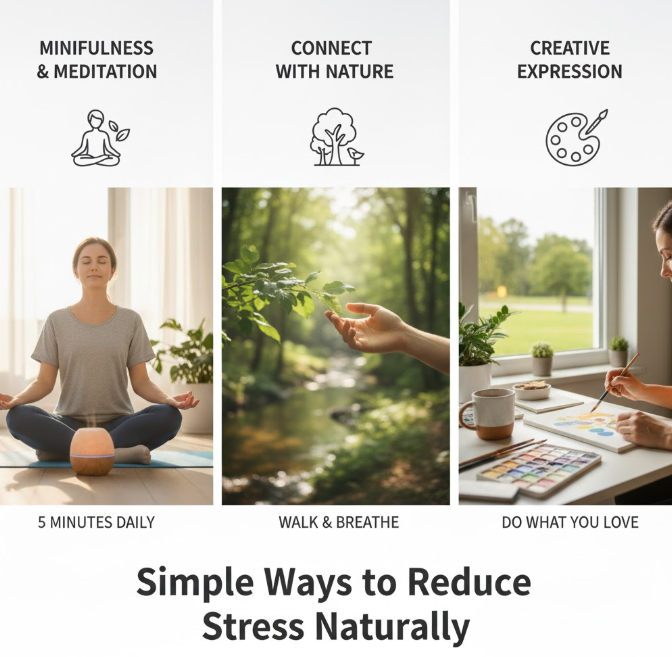
A study has found that one can reduce stress hormones with only 20 minutes in nature. You do not even require a forest or a mountain, a local park is all that is needed.
Disconnect with your phone during this period. Take a look at the trees, hear what birds can say, feel the air. Such conscious consideration enhances the effect of reducing stress.
Gardening as Therapy
Soil and plant activities relax your mind and provide you with moderately good exercise. You do not have to have a big area, even a couple of pots on the balcony will do.
There is a feeling of achievement and purpose in the process of watching something grow. And lastly, you are getting fresh herbs or vegetables.
Bring Nature Indoors
In case it is hard to be outside, bring the outside to you. Plants in the house make the atmosphere cleaner and more tranquil.
Plants that are easy to start with are:
- Cactus (almost impossible to kill)
- Pothos (grows in low light)
- Spider plants (purifies air)
You can also look at pictures of nature, a move which will help lessen stress even when you are trapped in the house.
Social Relations and De-stressing
Humans are social creatures. Good relationships give excellent safeguard against stress.
Talk to Someone You Trust
When you talk to a friend or a family member about your concerns, they become less emotionally burdened. You do not need solutions, at times, simply hearing you is a great relief.
Select individuals that listen without judging. Good listeners do not interrupt and jump at fixing your problems.
Help Someone Else
By volunteering or assisting others you are not thinking about your stress anymore. It also disseminates happy hormones in your body.
Simple ways to help:
- Visit a friend who is in distress
- Call a friend who is struggling with something
- Volunteer in a local organization
- Do a favor for a neighbor
- Give away things you do not need anymore
Set Healthy Boundaries
There are times when being stressed is caused by saying yes. There is no harm in turning down an invitation or a request when you are too full.
Sample response: Could you please think about me, however, I cannot do that now. There is no necessity to elaborate.
Mindfulness and Meditation for Beginners
Mindfulness refers to attentive present and nonjudgmental attention. It is one of the most studied ways of eliminating stress in a natural way.
Start With Just 5 Minutes
You do not have to sit cross-legged and sit long hours. Even five minutes of concentrated attention are a difference.
Basic meditation practice:
- Take your seat and shut your eyes
- Be aware of your inhalation and exhalation
- Wherever your thoughts have gone (they will), bring them back to your breath
- Continue for 5 minutes
That’s it. Don’t criticize yourself about getting distracted, that is normal, and it is a part of the practice.
Body Scan Meditation
This method gets the physical stress out of you that you may not be aware of.
Lie down comfortably. Beginning with your toes, give attention to each of the body parts in a few seconds. Pay attention to the tension and never attempt to shift it. Raise gradually up through your feet, legs, torso, arms, and head.
The whole scan process lasts approximately 10 minutes and leaves one in a highly relaxed state.
Mindful Daily Activities
Mindfulness can be practiced in the daily chores. Give your full attention to what you are doing as opposed to having your mind stray.
Try this while:
- Cleaning plates (touch the hot water, see the bubbles of soap)
- Tasting food (take each bite to the full before swallowing)
- Walking (put one foot in front of the other, be aware of what is going on around you)
This habit teaches your brain to be in the present and this is less worrying because of thinking either about the future or the past.
Creative Outlets for Stress Relief
Having something to be creative also provides a relief to your over-thinking mind and generates something physical.
Adult Coloring and Drawing
Coloring isn’t just for kids. The monotony of movement and emphasis on colors uses the same parts of the brain as meditation.
You may purchase adult coloring books, or you may doodle on plain paper. It is not about right or wrong, the working process is more important than the outcome.
Music for Your Mood
Music changes the brain chemistry when you listen to it. Slow and relaxing music reduces blood pressure and heart rate.
Design playlists according to various circumstances:
- Calming music for bedtime
- Upbeat songs for energy
- Nature sounds for focus
Further pressure on the brain is also relieved as playing an instrument involves the simultaneous use of several parts of your brain.
Writing It Out
It is possible to work through feelings and feel perspective by journaling. You do not require faultless grammar and complete sentences.
Try these prompts:
- What am I grateful for today?
- What’s bothering me right now?
- How can tomorrow be improved?
Write without judgment and without stopping 10 minutes. Write whatever comes to your mind.
Swift Stress-Reducing Strategies in Rushed Times
You want some relief quickly and therefore do not have time to practice long.
The 5-4-3-2-1 Grounding Method
This is a method of returning to the moment that you get anxious.
Identify:
- 5 things you can see
- 4 things you can touch
- 3 things you can hear
- 2 things you can smell
- 1 thing you can taste
The exercise is less than 2 minutes in length and it interrupts the stress response within a short period.
Progressive Muscle Relaxation
This technique involves increasing the intensity of the relaxation process.
Contract and release each muscle group for 5 seconds. Beginning with your fists then your arms, shoulders, face, stomach, legs and feet.
This contrasts the tension and relaxation to your body and thus to get rid of stress during the day becomes easier.
Cold Water on Your Wrists
Your wrists and behind your ears can be cooled with cold water. This has the effect of relaxing your body in mere seconds.
Creating Your Own Stress-Reduction Program
All people react to the methods of stress-relief. The trick is in doing what suits you most.
Start Small and Build
Don’t attempt to make everything different. Select one or two methods out of this guide and practice them every day for two weeks.
After these are made into habits, add another method. The slow, gradual changes take time compared to radical revolution.
Track What Works
Make a basic record of which methods you apply and the effect you have on yourself. Score your stress level at the beginning and end of the session out of 1-10.
Within a couple of weeks, trends will be developed regarding the most effective ways to approach it.
Develop Everyday Stress-Reduction Routines
Make stress management part of your daily routine:
- Morning: 5 minutes of breathing exercises
- Midday: 15-minute walk
- Evening: Before going to bed routine
Consistency is more important than perfection. When it is a busy day do a shorter version, not omit it entirely.
For more helpful wellness tips and resources, visit Cakvia.
Frequently Asked Questions
How long do the natural stress relief techniques take?
Some methods such as breathing exercises take minutes to work. Some such as exercising or sleep habits require 2-4 weeks of continuous care before the full benefits are realized. Go slow and use the strategies that are comfortable to you.
Is it possible to use several stress reduction methods?
Absolutely! Actually, it is usually better to combine methods, rather than use only one. You can do breathing exercises in the morning, walk during lunch and do meditation before bed. Identify a schedule and a mix that is convenient.
Are natural stress relieving techniques as effective as drug treatment?
In the case of mild to moderate stress, natural techniques are quite successful. Nevertheless, in case of anxiety or depression, these methods are effective when used together with professional help when they are very severe. It is important to seek medical attention when it is serious mental health. Learn more about stress management from the National Institute of Mental Health.
What if I don’t have time to practice stress-relief?
Several methods do not take more than 5 minutes. It helps even 2 minutes of deep breathing or walking around your building. Keep in mind that it is the actual stress management that will provide you with more energy and concentration, and you will achieve more in general.
How do I understand what technique is going to be the most effective with me?
All people are different, and experimentation is essential. Experiment with each of these at least one week. Identify the ones that are natural and which are those that you really look forward to. The most efficient method is the one that you will apply regularly.
Can children apply such methods of relieving stress as well?
The majority of these methods are excellent among children and adolescents. Specifically, breathwork, outdoor time, creative pursuits, and movement can be beneficial among the youth. These skills should be taught to children at an early age in order to enable them to cope with stress in their lives.
Your Path to a Calmer Life
Stress is a way of life, but it does not need to be running you. These straightforward techniques in this article provide you with actual instruments to improve yourself today.
You have studied the breathing exercises that relax your nervous system within minutes. Movement and exercise relieves tension besides enhancing your mood. Resilience is based on quality sleep and healthy foods. Natural time, social relationship and creativity provide relief beyond a superficial fix.
The first step is the most critical one; that is to start. Choose one of the techniques that seems appealing to you and practice it today. Just one. You cannot add more before you have mastered that.
Keep in mind that not everything happens in a straight line. There will be those days that are easier than others. That’s normal. Keep practicing and with time these natural stress relieving techniques will become automatic habits that will safeguard your health.
Nature has amazing healing powers in your body and mind. These methods are merely useful to stimulate them. Allow yourself to take care of yourself, you are responsible to feel relaxed, rested and able to cope with whatever life throws at you.
Begin by doing little and continue to do it regularly and see how these little habits will turn around your relationship with stress. The quieter, easier life that you seek is attainable.