
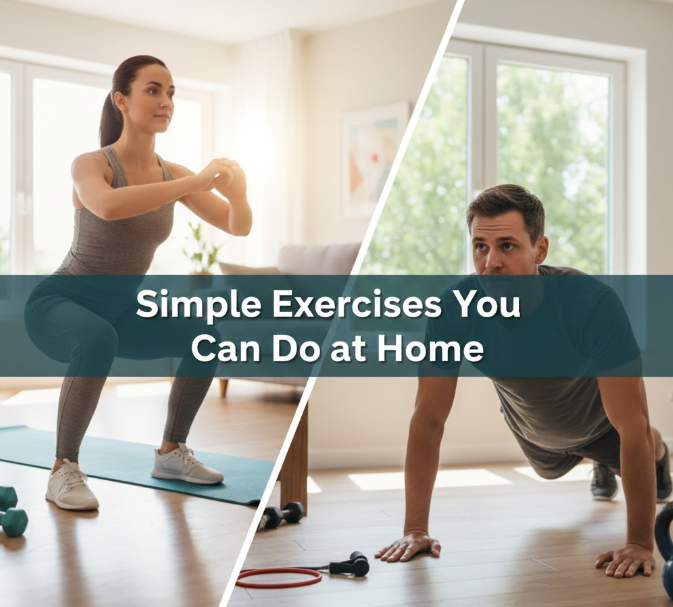
Why Home Workouts Are Becoming Popular
Home workouts are fast becoming popular among individuals because of the following reasons.
Fitting out does not require a gym membership and equipment. Your home provides you all you need to gain strength, become more flexible, and achieve more energy. The best part? You have the flexibility to work out at any time that is convenient to you to put on any clothes that feel comfortable.
Home exercises are time and money-saving and also allow you the freedom to be in charge of your own fitness. No matter whether you are a total beginner or simply need to renew your workout routines, at home you can eliminate most of the obstacles that make people not exercise on a more regular basis.
This manual will demonstrate effective real-world exercises. You will also learn the moves that will go to various parts of the body, develop your blood flow, and keep you stronger on a daily basis. No hard practices or costly devices needed.
The first step is taken in the right direction.
Getting Ready Before Starting
Being ready is one of the things you should do before starting any exercise. This is something that will keep your exercise safe and effective.
A few supplies are required before you start, and these are listed below:
You do not need to do much to create your workout space. Look in your house to find somewhere where you can move freely in every direction. Yoga mats or a soft carpet will support your joints, although a towel on a hard floor would be good.
Wear clothes which allow free movement. Athletic shoes support is just a convenience, and many exercises are more effective with bare feet or in socks. Always have a water bottle close so that you can remain hydrated during your workout.
Safety Tips That Must Be Followed
Pay attention to your body when exercising. It is good when you feel that your muscles are working, but when you experience sharp pain, then you have to stop. Begin with a low number in case you are a beginner at the exercises, repeating them fewer times and resting between them.
Proper breathing makes all the difference. Always do not hold your breath when exercising. Exhale in the difficult part of every movement and inhale in the easy part.
Warm-Up Workouts: Readying Your Body
Warming up increases your blood circulation and minimizes the chances of injury. These movements are done five to ten minutes prior to your actual workout.
Arm Circles and Shoulder Rolls
Keep your feet at a distance of shoulder width. Keep your arms straight in one direction on each side and make small circles forward for 30 seconds. Then turn and continue in another direction for another 30 seconds. As you get your shoulders loosening, make the circles bigger.
When rolling the shoulders, raise your shoulders up to your ears, roll them behind, down and forward. Do this ten times and change the direction.
Marching in Place
Raise knees and swing your arms in a natural manner. Pull your belly button in and keep your back straight. Warm up by marching for two to three minutes to increase the heart rate gradually.
Light Stretches
Extend your arms above your head and lean to the right and left. Hold each side for 15 seconds. Turn your ankles and wrists around. These simple movements arouse your joints and muscles.
Strength-Building Lower Body Workouts
The biggest muscles in the body are in the legs. They are more effective in burning calories and in enhancing your fitness.
Bodyweight Squats
Squats make your thighs, hips, and buttocks stronger and enhance your balance. Keep your feet slightly wider than hips. Turn your toes a little outwards.
Push hips back, as though you were sitting in a chair. Bend down till the thighs are parallel to the floor, or as far down as you can feel comfortable with. Keep your chest up and your knees tracking over your toes. Use your heels to get back on your feet.
Begin with ten squats in three sets. Take a one-minute break between sets.
Lunges for Balance and Power
Lunges train each leg separately, correcting imbalances in their strength. Keep your hands on hips and stand straight. Take a step with your right foot of about two feet forward.
Lower your body down until both knees are at a right angle. The knee of your back must be hovering just above the floor. Push through your front heel and go back to the starting point. Complete three sets of ten lunges for each leg.
Calf Raises
Use a wall for balance support. Stand up on your toes, and lift your heels as high as you can. Wait two seconds at the top then descend gradually. Do three sets of 15 repetitions.
Challenge yourself with single leg calf raises later when you are strong enough.
Glute Bridges
Keep your feet flat on the floor, hip-width apart and lie on your back with your knees bent. Push through your heels and lift your hips to the ceiling. Squeeze your buttocks at the top and hold for three seconds.
Lower down to the floor without putting your hips all the way down. Do three sets of 12 repetitions. This exercise will strengthen your glutes and secure your lower back.
No Equipment Upper Body Exercises
Strengthening the upper body makes you stand better and you can work without straining your body.
Push-Ups Done Right
Push-ups train your chest, shoulders and arms simultaneously. Begin in a plank pose with your hands slightly wider than your shoulders. Hold the body straight from head to feet.
Lower down by bending your elbows such that the chest is almost at the ground level. Push back up to the starting position. In case normal push-ups are too difficult, use knee-on-the-ground push-ups.
The goal is to have three sets of the maximum number of push-ups that you can perform well. Rest 90 seconds between sets.
Tricep Dips Using a Chair
Sit on a sturdy chair or couch. With your fingers facing forward, place your hands on the edge beside your hips. Slide your bottom off the edge with your hands supporting you.
Bend your elbows until they reach 90 degrees. Push back up straightening your arms. Keep your back close to the chair. Perform three sets of eight to ten repetitions.
Plank Holds
Planks make your entire core firmer. Take a position of push-ups, however, rest on your forearms rather than hands. Keep your back straight as a board.
Begin by holding this for 30 seconds. Rest, then repeat two more times. The stronger you get, increase hold time to one minute or more.
Superman Exercise
Lie down on your stomach on the floor with your arms straight over your head. Raise your legs, chest and arms up in the same motion. Hold for 5 seconds and squeeze the back muscles.
Lower back down with control. Do three sets of ten repetitions. This is an exercise that helps your whole back and also helps improve posture.
Core Strengthening Moves
A strong core will protect your spine and enhance your overall workout performance.
Bicycle Crunches
Lie on your back with your hands behind your head. Raise your shoulders and bring your knees to a 90 degree position.
Twist your body to face left, bringing your right elbow towards your left knee and extending your right leg straight. Alternate sides during a pedaling motion. Complete 3 sets of 20 repetitions (ten each side).
Mountain Climbers
Start in a push-up position. Bring your right knee to your chest and then at a very fast rate, switch your legs, bringing your left knee forward and the right leg back.
Keep on swapping fast as though you are running in place. Do 30 seconds then rest and repeat two more times. Mountain climbers exercise your core as well as accelerate your heart rate.
Side Planks
Lie on your side with one forearm on the ground, shoulder to the ground. You can stack your feet or put the upper foot forward to balance more easily.
Lift yourself up and make your body straight from head to feet. Hold for 20-30 seconds on each side. Complete three sets per side.
Home-Based Cardiovascular Exercises
Exercises that involve the heart and lungs make your heart stronger as well as burn calories.
Jumping Jacks
Stand with your feet together and arms close to your sides. Jump with your legs spread shoulder-width apart and your arms raised high above your head. Jump back to start position.
Perform jumping jacks for 1 minute followed by a 30-second break and repeat. Work up to three to five sets.
High Knees
Run in place with your knees pulled up to the max towards your chest. Pump your arms naturally. Always use the balls of your feet, and keep your core tight.
Do high knees for 30 seconds and rest after every set. Complete 3 to five sets.
Burpees
Burpees are a series of exercises that are combined into a single and powerful one. Begin standing before squatting down and placing your hands on the floor. Jump your legs back to a push-up position.
Do one push-up and jump your feet back to your hands. Jump up in the air with arms overhead. That’s one burpee.
Begin with five burpees, take a break and do three sets. Burpees are hard yet so powerful.
Stretching and Flexibility Routines
Stretching enhances your flexibility and prevents injuries. The stretches should be done after your workout when the muscles are warm.
Hamstring Stretch
Sit with one leg straight and one bent with the foot against the inner thigh. Lean forward towards your extended foot. Hold for 30 seconds, then change legs.
Quadriceps Stretch
Stand on one foot and pull the other foot towards the buttocks. Make sure your knees are kept together, and push your hips forward a little. Hold for 30 seconds per leg.
Child’s Pose
Sit back on the floor kneeling. Lay your arms on the floor in front of you and bring your chest down towards the floor. Breathing deeply, maintain this restful position for one minute.
Chest and Shoulder Stretch
Stand in a doorway with your elbow level to your shoulder, with your forearm against the door frame. Slowly turn your body away from your arm until you experience some form of stretch in your chest. Hold 30 seconds per side.
Sample Workout Schedule Per Week
Following a planned schedule will help you stay on track and achieve results.
| Day | Workout Focus | Duration |
|---|---|---|
| Monday | Lower Body and Core | 30 minutes |
| Tuesday | Cardio and Flexibility | 25 minutes |
| Wednesday | Upper Body and Core | 30 minutes |
| Thursday | Rest/Light Stretching | 15 minutes |
| Friday | Full Body Circuit | 35 minutes |
| Saturday | Cardio and Lower Body | 30 minutes |
| Sunday | Rest/Gentle Yoga | 20 minutes |
This program helps to maintain a balance between the various types of workouts and allows your body to rest. You can adjust any workout depending on your fitness level and available time.
Building Your Own Exercise Plan
Establishing a routine that suits you raises the possibility of you sticking to it.
Combining the Various Types of Exercises
Use a combination of strength activities, cardio exercises and stretching during each session. This diversity makes it interesting and it exercises your body differently.
There is a basic formula: 40 percent of your training should be spent on strength training, 40 percent on cardiovascular and 20 percent on stretching. Modify these percentages depending upon your objectives.
Tracking Your Progress
Write down exercises you do and the number of repetitions you complete. When you can notice that you are getting better week by week, it inspires you to continue.
Take photos after every two weeks. The scale does not always reflect the progress as seen in the mirror.
When to Increase Difficulty
When exercises become comfortable, challenge them. Add more repetitions, complete more sets or try variations that are more difficult. For example, standard squats can become jump squats or regular push-ups can become decline push-ups with the feet elevated.
Common Mistakes to Avoid
Knowing what not to do helps you advance at a much higher rate and remain injury-free.
Skipping the Warm-Up
Exercising cold increases the risk of injury significantly. You should never spend less than five minutes preparing your body. This little time spent will save you weeks lost to setbacks.
Using Poor Form
Performing exercises in the wrong way makes them ineffective and harmful. Concentrate on quality not quantity. One perfect squat beats twenty sloppy squats.
You can watch tutorial videos or check your form with the help of a mirror.
Doing Too Much Too Soon
Excitement is wonderful, but it is self-destructing when it is excessive. Begin slowly then add intensity. It is important that your body be able to adjust to new demands.
Forgetting to Breathe
Holding your breath during exercise increases blood pressure risk and decreases performance. Focused breathing will keep oxygen reaching your muscles and will ensure you maintain better form.
Staying Motivated Over Time
The initial stages of a fitness program are exhilarating, but it needs a plan to sustain it.
Setting Realistic Goals
Select specific, measurable goals such as doing 20 push-ups in a row or working out four times a week for a month. Smaller goals create confidence in achieving larger goals.
Write down your objectives and review them regularly.
Making Exercise a Habit
Work out every day at the same time. Your brain loves patterns and when you always do workouts at the same time, your workouts become automatic and not optional.
Prepare your workout clothes the previous night to act as a reminder.
Finding What You Enjoy
Not all people are fond of the same exercises. Keep trying different moves and routines until you find what works for you. Regular workouts become natural when you like what you do.
Adjusting Workouts to Various Levels of Fitness
We all begin at a different place. This is how to modify exercises to your present capacity.
Beginner Modifications
Reduce the number of repetitions by half and extend the resting periods. Use walls or furniture for support during balance exercises. Use knee push-ups as opposed to regular ones. It is more important to learn the proper form before adding intensity.
Intermediate Progressions
Increase the repetitions and shorten the rest periods between sets. Add a little bit of difficulty by holding weights or performing slower exercises. Move through circuits with minimal rest.
Advanced Variations
Attempt explosive exercises such as jump squats or plyometric push-ups. Hold positions longer or include unstable surfaces. Construct complex circuits that involve more than one skill at a time.
Nutrition Fundamentals for Home Workouts
Nutrition is combined with exercise. You do not have to have a complex diet, but rather follow clever fundamentals.
Eating for Energy
Consume carbohydrates prior to exercises as a source of energy. Bananas, oatmeal or whole grain toast are good alternatives. Eat light food an hour or two before exercise.
Recovery Foods
Carbohydrates are required to restore energy after an exercise, and protein is needed to repair muscles. Chocolate milk, Greek yogurt with fruit, or a turkey sandwich would all be fine choices.
Staying Hydrated
Drink water before, during and after exercise. Strive to consume no less than eight glasses of water per day with extra glasses on exercise days. Dehydration decreases performance and increases recovery time.
Frequently Asked Questions
How much time should I spend exercising?
Aim for 30 minutes of moderate exercise most days of the week. Even 10 to 15 minutes brings you benefits when you are only starting. You can divide this into smaller sessions throughout the day.
Is it possible to get in shape with no equipment?
Absolutely. All the resistance that is required during effective workouts is provided by your body weight. Most athletes can keep fit by just exercising with bodyweight. Equipment is optional but not essential.
How soon will I see results?
In two weeks, you will feel more energized and strong. It normally takes four to six weeks of regular exercise before visible physical changes are realized. Everyone develops at a different pace depending on initial fitness and effort.
Should I exercise if I’m sore?
Light soreness is normal and there is nothing wrong with exercising other muscles. Sharp pains or severe soreness implies the need to rest. You must listen to your body and rest when you need it.
What if I miss a workout day?
Skipping some workouts will not bring your progress to a halt. Just move on to your next scheduled session. Consistency across months is more important than perfection on a weekly basis.
How many days should I rest in a week?
Have at least one or two full days off per week. Rest enables your muscles to restore and to become stronger. On these days active recovery such as walking or light stretching can be effective.
It Is Your Time to Jumpstart Your Fitness
Home-based exercises are simple and provide a viable solution to improved health and fitness. You have been taught movements for each of the major muscle groups, heart health, and flexibility. These workouts do not need special equipment, gym membership, or complex instructions.
Begin with the exercises that are comfortable and then progressively incorporate more challenges. Consistency is what is crucial for lifelong exercise routines. As little as 15 minutes of exercise a day brings positive effects in strength, energy levels and general wellbeing.
Everything needed to make you successful is in your home. Make some space, select some exercises from this guide and take the first step now. Every exercise will take you one step closer to feeling better, healthier and more confident in what your body can achieve.
For more health and wellness tips, visit Cakvia. You can also learn more about the benefits of home workouts from the American Heart Association.
You should remember that fitness is an individual journey with no need for comparison with other people. Praise yourself, be patient with yourself and each day enjoy the process of getting stronger. The ideal exercise is the one that you will perform consistently, so find what suits you, make it a habit to show up and work on yourself weekly.