
When you sleep, your brain does not go to sleep. In fact, it is striving very hard to maintain your mind in good and healthy condition. Lack of good sleep can disorganize your feelings, your powers of thought and even alter your perception of the surrounding world.
Both sleep and mental health are intertwined and the scientists are yet to find out. Lack of sufficient rest increases your vulnerability to anxiety and depression. Sleeping becomes more difficult when you have to cope with mental issues. It is a cycle that reaches out to millions of people every day.
This article uncovers precisely the way sleep influences your state of mind, what occurs in your brain when you are in various stages of sleep, and how you can practically enhance your sleep, as well as your moods.
Nightly Maintenance Schedule in Your Brain
Imagine sleep to be the cleaning crew of your brain. When you are in bed, your brain is busy eliminating waste products that accumulate throughout the day as toxic wastes. This is referred to as the glymphatic system, and is most effective when one is in deep sleep.
Sleep time is also the time of organization of memories and emotion processing in your brain. Have you ever found that after a good night a problem appears smaller? It is your brain literally rearranging information and putting it into perspective.
When you are in the REM (Rapid Eye Movement) sleep, your brain processes day emotional experiences. It is as though your mind is storing feelings and determining what to keep in mind. Lack of sufficient REM sleep may accumulate negative feelings which may subsequently overwhelm you.
What Occurs on Each of the Sleep Stages?
Your sleeping pattern is repeated 4-6 times in a night. Every cycle takes approximately 90 minutes and consists of various stages that can be performed to accomplish a particular purpose to your mental health.
Stage 1 is the light sleep stage in which you fall asleep. The muscles become loose and the brain waves slow. This only lasts a few minutes.
The second level is known as Stage 2 in which your body temperature decreases and the heart rate decreases. Here the memories are processed by your brain. This stage occupies some half of your night.
Stage 3 is deep sleep known to be the most restorative stage. Your body takes itself apart and your brain gets rid of waste. This is the time of releasing growth hormone.
The majority of dreaming occurs during the REM sleep. Your brain is nearly as active as it would be when you are awake. It is an important phase of emotional regulation and learning.
| Sleep Stage | Duration per Cycle | Benefits to Mental Health |
|---|---|---|
| Stage 1 (Light Sleep) | 1-5 minutes | Transition and relaxation |
| Stage 2 (Light Sleep) | 10-25 minutes | Memory consolidation starts |
| Stage 3 (Deep Sleep) | 20-40 minutes | Brain detoxification, emotional reset |
| REM Sleep | 10-60 minutes | Emotional processing and learning |
Poor Sleep is Connected to Anxiety in the Following Way
Failure to sleep adequately causes your brain to be hyper responsive to stress. The section of your brain that interprets fear and emotions, your amygdala, is up to 60% more active when you are sleep-deprived.
This implies that minor concerns might seem as giant problems. The slight issue at school or work place can lead to a full-fledged panic. Your brain is just unable to distinguish between real threats and daily challenges.
The first place is also difficult to fall asleep because of anxiety. Your mind is busy with concerns, your body remains in a state of tension and you even find yourself staring at the ceiling and spend hours doing so. This poses an irritating cycle because poor sleep leads to anxiety and vice versa.
Physical Indications of Sleep-Related Anxiety
Anxiety in your body also presents itself when you fail to sleep well. You might notice:
- You jump up when you sit down
- You feel your heart beat without any movement
- Spasmodic muscles in your shoulders, neck or jaw
- Nausea or stomach problems
- Digestive problems or nausea
- Headaches that won’t go away
- Sensual jitters or nervousness
These bodily ailments no longer allow one to unwind and sleep at night. Your body is in hyper alertness and it cannot relax itself.
Sleep Struggle and Depression
Approximately 3/4 of individuals suffering depression experience difficulty in sleeping. Some can’t fall asleep. Other people are in a position of waking up more than once in a night. There are a lot of those who wake up too early and are unable to fall again to sleep.
Sleep deprivation alters the chemicals in your brain which control mood. Serotonin and dopamine that make you feel good should decrease when you are deprived of sleep. Meanwhile, the levels of stress hormones such as cortisol remain high.
Depression also plays with your body clock and that is the circadian rhythm. You may be sleepy all day long and wake up at 2 AM. Or you can sleep 12 hours yet get up drained.
The Energy Drain Cycle
Everything takes more effort when you are not sleeping well and are depressed. It is impossible to get out of bed. Even such easy activities as showering or making a breakfast become overwhelming.
This loss of energy will lead you to do less of activities that can benefit you such as exercising or meeting friends. You spend your time staying indoors, your lifestyle collapses and your sleeping habits become worse.
This cycle should be broken in small but manageable steps. Even the slightest changes in sleep will begin clearing the mist of depression.
Sleep Deprivation and How It Alters the Way You Think
It is not only the mood that is influenced by sleep deprivation. It alters your brain and its information processing and decision-making.
The prefrontal cortex is that section of your brain that does the planning and regulates your behavior, and when you are fatigued, it works at a small fraction of its normal speed. That is why you have poor decision-making when you are tired.
The reduction of concentration is achieved after only a poor sleep. You will find that you cannot concentrate on conversations, you keep losing focus as you read, you can forget what you were about to say in the middle of the sentence, etc.
This is bad as your brain is not able to consolidate new information properly to form memory. There is no use studying when one is sleep-deprived. Most of what you are trying to learn is not going to be retained in your brain.
Problem-solving skills reduce drastically. Things that are usually simple are made to seem like aggravating puzzles. You end up getting stuck with the simple issues that you would normally be able to solve within seconds.
Decision-Making Gets Risky
Sleep deprivation causes you to be impulsive and less cautious. Research has indicated that the fatigued individuals engage in larger risk taking and make more careless decisions.
It is also more probable that you will be wrong in interpreting social situations when you are exhausted. Someone may be having a bad day and may appear to be angry with you. Or you may not notice the social signals at all.
This may hurt relationships and would bring out unnecessary conflict. So the brain is not sleeping, and it is not comprehending normal interactions.
The Sleeping Requirements and the Teenage Brain
Adolescents should have access to 8-10 hours of sleep in a night, but they usually receive much less. Their circadian rhythms change automatically with puberty and they desire to sleep late and wake up late.
It is unfortunate that there is a conflict between this biological need and the early school start time. The idea of teens getting up 6 AM in the morning is the same as adults getting up 4 AM in the morning to go to work. Their heads are not even prepared.
The impact of this deficit of sleep on the mental health of teenagers is deadly:
- Increased levels of depression and anxiety
- More self-harm and suicidal ideation
- Increased tantrums and irritability
- Academic poor performance regardless of studying
- Increased risk-taking behavior probability
The Reason Why Teen Brains Are More Susceptible
The brain of the teenager is still under development especially the prefrontal cortex. This area is not going to reach full maturity until the mid-20s.
This development process is of critical importance to sleep. The brain development of the teens can be negatively impacted when the teens do not get a sufficient amount of rest. The emotional control becomes more difficult, and mental conditions are more probable to arise.
This is aggravated by social media and smartphones. The blue light of the screens overrides melatonin, which is a hormone that makes you feel sleepy. Scrolling in the late hours takes the time of bedtime.
Stress, Cortisol and Your Sleep Cycle
There is a complex correlation between stress and sleep. Even some stress can make you wake up and be alert. However, chronic stress kills your sleeping habit.
The stress hormone is cortisol, which is released in your body when you are stressed. The level of cortisol in the body varies as a natural process in the course of the day. They are supposed to be highest in the morning to wake you up, and least in the evening to sleep.
Persistent stress maintains high levels of cortisol throughout the day and night. This renders sleeping almost impossible. Your body believes that it must remain vigilant.
Although you may fall asleep with high levels of cortisol, the quality of your sleep is compromised. You do not sleep as much in deep sleep and more in light sleep. You are waking up and you are not even resting.
Breaking the Stress-Sleep Cycle
Have you been dealing with stress throughout the day and you are getting better sleep at night? This does not imply that one should get rid of every stress, which is not possible. It is seeking healthy means of processing and discharging it.
Exercise can also be considered as one of the best stress relievers. Work burns up excessive cortisol and adrenaline. A 20 minutes walk will be enough.
Before sleep, relaxation methods can help your body to know that it is safe to sleep. Cortisol levels can be reduced by deep breathing, progressive muscle relaxation, or by light stretching.
Making the Sleep Environment Friendly
The bedroom setting is a big factor in the quality of sleep. It does not take many alterations to help you sleep better and be in a better state of mind.
Temperature is an issue bigger than anticipated. To sleep, your body must be cooled down. The optimal temperature of the bedroom should be 60-67°F (15-19°C).
Melatonin production depends on darkness. The lights of the phones, the alarm clocks or even the street lights can interfere with your sleep even in small quantities. Wear blackout covers or an eye mask.
Noise control assists you to sleep during the night. White noise players or earplugs can assist in case you are in an environment where there is a lot of noise. Others are comforted by sound of nature.
The comfort is subjective and significant. Your bed, bedding and pillows must be comfortable. When you wake up with soreness and pain, then it is the time to change.
Still, the Pre-Sleep Routine That Works
Your pre-sleep activity determines whether you will sleep or not. Establishing a regular routine conditions your brain to know when it is time to relax.
Quit the use of screens before bedtime, 30-60 minutes. The blue light deceives your mind into believing that it is still daytime. In case you have to use devices, switch on night mode or wear blue light blocking glasses.
Do something to ease and soothe. Read a real book, take a warm bath, listen to soft music, or follow some gentle yoga. The practice is not as important as the regularity.
Eat not too much, caffeine, and alcohol near bedtime. Caffeine has a half-life of 6-8 hours. Alcohol may also cause drowsiness but later at night it affects the quality of sleep.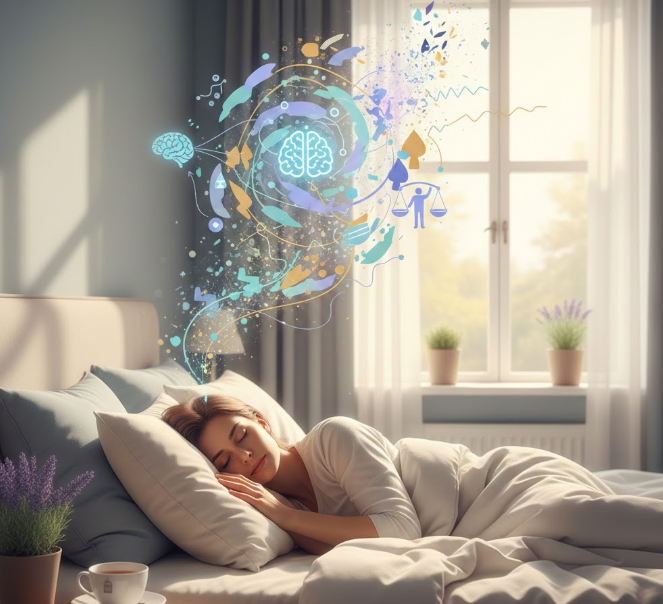
The Question When It Is Necessary to Consult the Professional Help
In some cases, sleep dysfunctions and mental disorders require treatment. You need not attempt to go it alone when you are feeling:
- Insomnia prolonged to over several weeks
- Suicidal thoughts or thoughts of harming others
- Panic attacks that wake you up at night
- Mood swings of extreme swings at the expense of your day-to-day life
- Experience sleep paralysis or scary nightmares on a regular basis
A therapist would be able to assist you in improving your sleeping habits and working on underlying mental health issues. Particularly effective is Cognitive Behavioral Therapy for Insomnia (CBT-I). Learn more about mental health resources at cakvia.com.
Physicians are able to screen sleep disorders such as sleep apnea or restless leg syndrome that have impacts on mental health. There are particular treatments to these conditions.
There is nothing wrong with seeking assistance. Sleep issues and mental health problems are extremely widespread, and there are established ways of treatment.
Easy Everyday Routines to Sleep Well and Live Happier
Even by taking small steps one can make big changes in the long term. You do not have to totally change your life in one night.
Exposure to morning sunlight assists in the normalizing of the circadian rhythm. Take a 10-15 minutes walk outside an hour after waking up. This informs your brain that it is daytime and this part of the brain makes you sleepy at the appropriate time.
Exercise is beneficial as it enhances sleep and mental wellness. Goal of 30 minutes movement most days. Simply do not do vigorous exercises under 3 hours before bedtime.
The importance of a regular wake-sleep time schedule is greater than it may seem. A bed time and waking up at a fixed time even on weekends condition the internal clock of a body.
Mindful eating helps in enhancing sleep. Never go to bed either hungry or full. A small protein rich and complex carb snack would suffice in case you are a bit hungry.
The stress management during the day time aids to stay calm during the night. Take time off, practice deep breathing and solve problems as they arise instead of letting them accumulate.
Recovery Is a Time-Consuming Process
One good night will not solve all your problems, in case you have been sleep-deprived during weeks, months, or years. It takes time to recuperate properly with your brain and body.
The vast majority of people will feel better in a couple of days of increased sleep. Your spirits uplift and you become less distracted and your energy is restored. However, it may take weeks to get fully out of chronic sleep deprivation.
Give yourself time in this process. You may be irritated that you are not seeing results as fast as you would want. Note that each night of good sleep is also an investment in your mental health.
Keep a journal on your sleep and mood to follow the patterns and improvements. There are times when the progress is slow such that you are not aware of it in the day-to-day life. Look back over weeks, and see how far you’ve been.
Frequently Asked Questions
What is the number of hours of sleep required to be in good mental health?
A majority of adults require 7-9 hours of quality sleep daily. Teenagers need 8-10 hours. Nonetheless, personal needs are somewhat different. The only indicator is the way you feel throughout the day. When you are awake, attentive and emotionally stable, then you are likely to be receiving adequate sleep.
Am I able to make up on sleep over the weekends?
Another solution to sleep debt is to sleep more on weekends, but that does not solve the problem. Abnormal sleep patterns make your circadian rhythm disoriented. Having regular sleep at night is far much better than sleeping deprivation followed by catch-up sleeping.
Why do I become more nervous at night?
At night anxiety tends to be more so as there are not many distractions. Activities and responsibilities usually occupy your mind in the daytime. During the time of night when everybody is silent, then concerns can spread. It is natural but can be controlled by relaxation methods and improved sleeping patterns.
Is it normal to dream each night?
Yes, all people dream at night under the REM sleep, and they normally dream 4-6 times. You simply do not always recall your dreams. Dream recall can be impaired by stress or the quality of sleep or by waking up in non-REM sleep. Bright or upsetting dreams could also mean that you are not digesting emotions in the day.
What is the duration of fixing the sleep schedule?
It usually requires 1-2 weeks of regularity to get yourself on a new sleeping schedule. Circadian rhythm requires some time to get adjusted. Take your time and change the bedtime by 15-30 minutes every few days instead of attempting to change everything simultaneously.
Should I sleep in naps when I am sleep-deprived?
Brief naps (20-30 minutes) in the early afternoon may be useful in terms of alertness without disturbing sleep in the evening. Napping late in the day or longer naps can result in not falling asleep at the end of the day. When you are always sleep-deprived, it is more important to emphasize on enhancing nighttime sleep instead of using naps.
Can my mental health be improved by supplements such as melatonin?
Melatonin will be able to assist with sleeping, particularly when you have an irregular circadian rhythm. But it is not a medical cure to mental health problems. Never take any supplements that are not prescribed by the doctor because they may react with drugs and are not suitable to all people.
Why am I tired even after getting 8 hours of sleep?
This can be caused by poor sleep quality, sleep disorders such as sleep apnea or by waking up in deep sleep stages. Additional reasons are dehydration or unhealthy diet, physical inactivity, or health problems. In case this continues to happen, seek medical care.
Sleep Tonight, and It Will Be Your Sleep Journey
It is not just the relationship between sleep and mental health in terms of feeling tired or alert. It is all about allowing your brain space to balance its emotions, experience, and keep the mind healthy.
Any minor change in your sleeping patterns produces beneficial effects in your psychological state. Improved attention in school or the workplace. Be more patient towards friends and relatives. The ability to withstand adversity.
You don’t need to be perfect. The loss of one night sleep will not reverse all the gains. It is the general trend and your resolve to ensure that sleep is a priority.
Mental health should be given the same attention that you pay to other health dimensions. And one of the best weapons to defend and better your emotions is to get good sleep.
One change a night. Perhaps, it is putting your phone away 30 minutes before. Or establishing an evening routine. Minimal actions have long-lasting changes to your sleep and your mental well-being.