
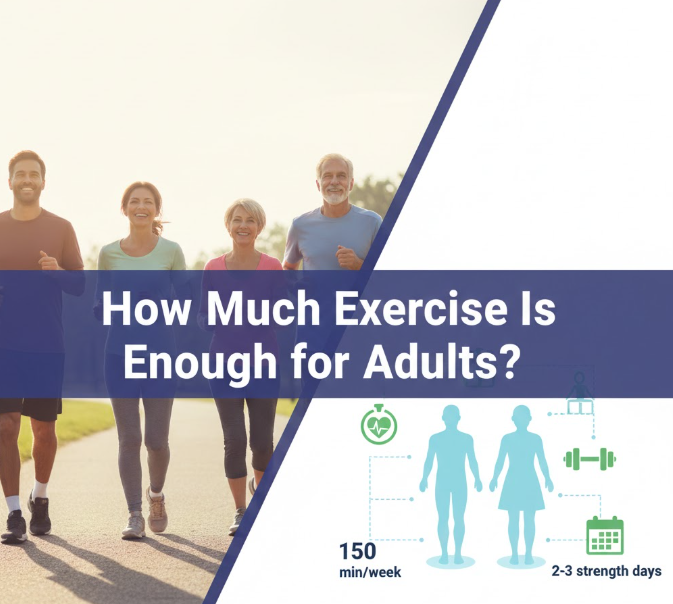
What Is the Necessary Amount of Exercise in Adulthood?
Your alarm goes off at 6 AM. Three times you snoozed and then dragged yourself out of bed. Business, household chores and before you know it, it is 10 PM. Where did the day go? And when on earth were you to have some exercise?
You’re not alone. This is the same question that millions of adults have to grapple with on a daily basis. The good news? Exercise does not require one to spend hours in the gym. As a matter of fact, you may be surprised to learn how much physical activity you require.
This guide also breaks down the specifics of how much exercise adults actually need, why it is important, and how you can do it without losing your head and fitting it into the busy life.
The Magic Numbers: What Health Experts Do Recommend
Let us come to the point. There are obvious guidelines that are set by the Centers for Disease Control and Prevention (CDC) and World Health Organization (WHO) regarding adults aged between 18 and 64.
Here’s what they say:
Moderate-intensity aerobic exercise: 150 to 300 minutes per week
Vigorous-intensity aerobic exercise: 75-150 minutes a week
Muscle-strengthening exercises: Minimum 2 days a week
Think of it this way. Even at the speed of 30 minutes of walking, five days in a row, you would reach the minimum. That is not as much time as majority of the people spend scrolling social media.
Breaking Down the Numbers
| Type of Activity | Weekly Minutes | Examples |
|---|---|---|
| Moderate Aerobic | 150 minutes | Brisk walking, casual biking, water aerobics |
| Vigorous Aerobic | 75 minutes | Running, swimming laps, jumping rope |
| Muscle Training | 2 sessions | Weight lifting, resistance bands, bodyweight exercises |
| Flexibility | 2-3 sessions | Stretching, yoga, tai chi |
You can also mix and match. A minute of vigorous exercise is equivalent to two minutes moderate physical activity. Therefore you get more or less the same benefits of 25 minutes of running as you do with 50 minutes of walking.
What is Considered Moderate Exercise vs. Vigorous Exercise?
This is a straightforward test that you can do at the moment.
Moderate intensity: You are able to talk and not sing during the exercise. What an acceleration in breathing, yet you are not breathing in need. After ten minutes or so you will be sweating.
Examples include:
- Brisk walking (typically 3 to 4 miles per hour)
- Riding a bike on flat ground
- Playing doubles tennis
- Pushing a lawn mower
- Dancing at a steady pace
Vigorous intensity: You can utter a few words before you should stop and take out your breath. Your pulse just soars. And you will be sweating inside a few minutes.
Examples include:
- Jogging or running
- Swimming continuous laps
- Playing basketball
- Cycling fast or uphill
- Jumping rope
- High-intensity interval training (HIIT)
The key difference? What a drag your heart and lungs have it. All the advantages of both are amazing, but when it comes down to the time you have to spend on it, vigorous exercise will provide a greater payoff.
Why These Numbers Really Count as Far as Your Health is Concerned
It is not about being skinny to wear jeans. The study indicates that achieving these weekly goals can add years to your life literally.
The Largest-Scale Safeguarding of Disease Occurrences
Exercise will reduce your risk of:
- Heart disease (by up to 35%)
- Type 2 diabetes (by up to 50%)
- Colon cancer (by up to 50%)
- Breast cancer (by up to 20%)
- Stroke (by up to 35%)
- Early death (by up to 30%)
These aren’t small numbers. And we are discussing reducing by half the risk of some of the largest health dangers we face as adults.
Benefits of Mental Health You Can Sense
Workout is a kind of antidepressant on its own. Endorphins and other feel-good chemicals get released in your brain after only 20 minutes of activity.
Individuals with exercise routines report:
- Less anxiety and stress
- Better sleep quality
- Higher energy levels during the day
- Sharper memory and focus
- Increased energy to address day-to-day activities
A study had established that exercising thrice a week was as good as antidepressant medication in some individuals with mild to moderate depression.
Everyday Life Gets Easier
Other than avoiding illness, exercising promotes making daily tasks easier. You’ll notice:
- Groceries are easier to carry
- It is easier to mingle with children or grandchildren
- You are never breathless after climbing up and down the stairs
- Your posture improves
- Improvement of balance, decreased risk of falls
These may not be huge but they will contribute to a better quality of life.
How to Construct Your Fitness Routine
Now let’s get practical. But how do you make 150 minutes a part of your week?
The 30-Minute, Five-Day Plan
It is the most popular technique. 30 minutes of exercise on 5 days. Have two days off, to rest and have a rest.
Sample Week:
- Monday: 30-minute brisk walk
- Tuesday: 30 minutes strength training
- Wednesday: 30-minute bike ride
- Thursday: Rest day
- Friday: 30 minutes swimming
- Saturday: 30 minutes yoga and strength training
- Sunday: Rest day
The Weekend Warrior Approach
Short on weekday time? Studies indicate that even when you squeeze your workouts within 1-2 days, it would still be effective provided that you meet your weekly goals.
Sample Weekend Schedule:
- Saturday: 60 minutes hike and 30 minutes strength training
- Sunday: 45 minutes bike ride and 15 minutes core work
Increase the time to 15 minutes of walking during the lunch breaks on the Monday to Friday, and you are golden.
The 10-Minute Burst Method
Not able to get 30 uninterrupted minutes? Break it up. A series of three 10 minutes walks during the day will be as good as a single 30 minutes.
This strategy is very effective among individuals whose time schedules are unpredictable. Fit in some exercise whenever you can find an opportunity.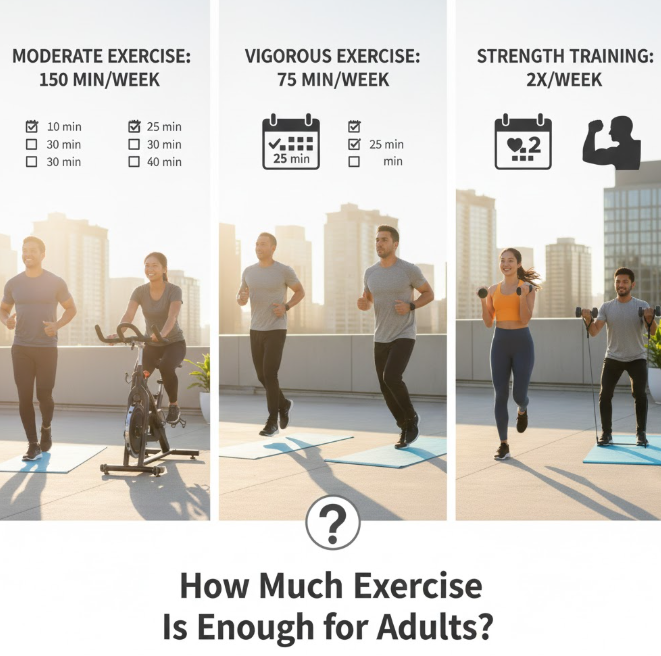
Strength Training: The Requirement That Is Often Disregarded
Here’s what many people miss. The two days of activities that strengthen the muscles are not additional. They are critical components of the suggestion.
What is Considered Strength Training?
You do not have to have an expensive gym membership. Strength training includes:
- Weight lifting (dumbbells, barbells, kettlebells)
- Using resistance bands
- Bodyweight exercises (push-ups, squats, lunges)
- Intensive gardening (digging, transporting goods)
- Yoga that challenges your muscles
- Rock climbing
The aim is to exercise all the major muscles: legs, hips, back, abdomen, chest, shoulders, and arms.
How Much Weight Should You Lift?
Select a weight that gives the final 2-3 repetitions of a set some effort. When doing 15 reps, which you can easily do, then that is too light. When you are not able to perform 8 good reps, then it is too heavy.
The desired target of most is 8-12 repetitions per exercise with 2-3 sets.
It Has Advantages Other Than Large Muscles
Strength training is special in its benefits and cannot be compared to cardio:
- Strengthens bone mass, which prevents osteoporosis
- Accelerates the metabolism, which aids in weight loss
- Increases insulin sensitivity
- Reduces lower back pain
- Makes everyday tasks easier
- Helps keep your muscles strong with age
Beyond the 30th year, after every ten years, adults lose between 3-5 percent of their body muscles without engaging in muscle training. This loss speeds up after 60. This decline is prevented and even reversed by regular resistance training.
Special Considerations for Various Age Groups
The general suggestions apply to the majority of adults, but your needs can be different.
Adults Ages 18-40
You’re in your physical prime. It is the right moment to establish a solid workout base.
Consider adding:
- Increased intensity of exercise (objective: the higher half of recommendations)
- Sport-specific training in case you engage in recreational sports
- Flexibility work to avoid future injury
Adults Ages 40-60
The exercise targets may remain the same, however, your body may need more time to recover.
Focus on:
- Strength training to sustain muscle mass
- Low-impact cardio in case of joint issues
- Fall prevention exercises for the future
Adults Ages 60+
These rules are the same, only that, you need to listen to your body more closely. In case 150 minutes is too aggressive, then begin with less and increase slowly.
Prioritize:
- Stability and balance movements
- Light weight training to sustain independence
- Things that you like (then you will stay at it)
Balance training is an activity that is prescribed by many fitness professionals to older adults. Dangerous falls may be prevented by simple exercises such as standing on one foot or walking on the heels.
What Will You Do If You Are Unable to Meet the Recommendations?
This is the fact that the fitness influencers do not want you to know: a little exercise is always a good thing.
Studies indicate that 60 minutes of moderate exercise weekly are of great health benefits. You may not be able to have the fullest protection against sickness, but you will be far ahead of a person who does nothing.
Starting from Zero
Assuming you are not physically active, then do not immediately jump to 150 minutes. A recipe to burnout or be injured.
Try this progression:
- Week 1-2: 10 minutes of exercise, 3 days a week
- Week 3-4: 15 minutes work, 3 days/week
- Week 5-6: 20 minutes activity, 4 days per week
- Week 7-8: 25 minutes of exercise, 4 days/week
- Week 9-10: 30 minutes of exercise, 5 days a week
This will be a gradual process of adjustment of your body. This is a lifetime habit you are developing and not taking part in Olympics.
When Health Issues Limit You
The fact that you have chronic conditions does not always imply that you are not allowed to exercise. You only have to be smart about it.
It is important to talk to your doctor first before embarking on a new exercise program in the event that you have:
- Cardiovascular disease or hypertension
- Diabetes
- Arthritis or joint problems
- Lung diseases such as asthma
- Recent surgery or injuries
Your doctor will in the majority of instances promote exercise with a few adjustments. They may refer a physical therapist who would be able to help you with a safe program, which would fit your situation.
Exercising Happily Ever After
It is one thing to know the amount of exercise required. It is another thing to do it week after week. For more health and wellness tips, visit Cakvia.
Choose the Activities that You Like, Not Hate
This is just common sense yet so many individuals make themselves run when they despise running. Or attend a gym when they hate gyms.
The most appropriate exercise is the one that one will do. If you love dancing, dance. Hike, should you like hiking in nature. Hate being alone? Join a group fitness class.
Set an Appointment
Workout that occurs every time you have time is not likely to occur. Take your physical activity as any other important appointment.
Put it in your calendar. Set phone reminders. Prepare your exercise garments the previous night. Get rid of all the potential obstacles.
Track Your Progress
It is highly motivating to see improvement. Maintain a basic record of your exercises. Record the way you feel before and after.
Numerous individuals feel that they can be consistent with the help of fitness applications or smartwatches. The information and streaks generate positive force to continue.
Identify an Accountability Partner
By making promises to someone, you are 65 percent more likely to continue with exercise. Get yourself a fitness partner, go to an exercise group, or have a friend that you discuss your objectives with and that will follow up on you.
It can be as simple as sharing your exercise on social media. Public commitment enhances follow-through.
Things to Avoid in the Quest for Fitness
Doing Too Much, Too Soon
Excitement is good until the point of injury. Going from nothing to intense workouts a day is generally a disaster.
Your body needs time to adapt. The rate of strength of muscles, tendons and ligaments is different. Go too far and there is a break.
Skipping Rest Days
More isn’t always better. It is the recovery that makes your body stronger and not the workout.
Rest days avoid overtraining syndrome that can result in you being tired, sore and more prone to sickness.
Ignoring Pain
There is a difference between discomfort (normal) and pain (a warning signal). When it feels hurt in a sharp or shooting part, then stop instantly.
Thousands of people attend physical therapy annually due to the no pain, no gain philosophy. Don’t be one of them.
Not Warming Up and Cooling Down
Most exercise-related injuries can be avoided by spending 5 minutes in warming up and 5 minutes in cooling down. Your muscles require time to change in and out of extreme exercise.
An effective warm-up slowly raises your body temperature and is known to loosen your muscles. A good post-workout recovery helps to eliminate waste products and alleviate the following-day soreness.
Frequently Asked Questions
Is it possible to divide my 30 minutes into three 10-minute sessions?
Absolutely. Studies have shown that a workout divided into smaller sessions during the day does not have any disadvantages when compared to a single session. This method can even be more convenient to incorporate into the hectic schedule.
Is walking sufficient exercise or should I do more?
Brisk walking is moderate intensity exercise and it definitely will get you up to the requirements. But then you are also to include strength training at least twice every week in order to be fully fit. Walking will not develop the muscle and bone strength required in your old age.
What are the indicators of whether I am working at the appropriate intensity?
Use the talk test. When performing moderate exercise, you can talk but not sing. When you are doing intense physical activities, you are able to say a few words then you have to take a breath. To be more exact, moderate activity should target 50-70 percent of your maximal heart rate and vigorous activity should target 70-85 percent.
What if I miss a few days? Should I do more to compensate?
Do not attempt to make up in a day or two all the lost hours of exercise. This increases injury risk. Just resume with your usual schedule, instead. It is consistency over time that matters as opposed to mastering every single week.
Do house chores qualify as exercise?
Some do, some don’t. Moderate-intensity activity includes vigorous cleaning, gardening, heavy loads and push-mowing the lawn. Light chores such as cooking or washing up do not increase your heart rate enough to contribute to your weekly goals.
Is it possible to have the same workout on a daily basis?
Consistency is desirable but doing the same workout every day can lead to overuse injuries and plateaus. Try to mix up your activities during the week. Blend different forms of cardio, switch between upper and lower body strength training, and have flexibility training.
Which is more appropriate: to workout in the morning or in the evening?
When you will exercise, it is always best to exercise then and not later. Some research indicates that morning exercises assist in forming habitual behaviors whereas evening exercises may enhance performance because your body temperature is higher in the afternoon. Select anything that is compatible with your schedule and energy.
The Bottom Line: Begin Where You Are
This is what you should keep in mind when it comes to the amount of exercise that is sufficient for adults.
It is prescribed 150 to 300 minutes moderate activity or 75 to 150 minutes vigorous activity weekly with well-rounded strength training 2 times per week.
However, when you are beginning all the way back, any movement is better than inactivity. Even ten minutes a day count toward your health.
Do not let the perfect be the enemy of the good. There is no need to be equipped with costly machines, gym, and athletic ability. You only have to exercise your body every now and then, by doing things that will put you just out of your comfort zone.
The adults who manage to stick with exercise routines are those who:
- Build slowly and create gradually
- Choose things that they really love
- Plan workouts as you plan any other thing
- Do not tear themselves up because of missed days
- Pay attention to how they feel, and not only how they look, as a result of exercise
Your body was made to move. Feed it and it will compensate you with more energy, health and a longer and happier life.
The question is not whether there is enough exercise or not. It is what you are going to do today to make yourself better.
Even a 10 minute walk in your neighbourhood is an ideal solution.